
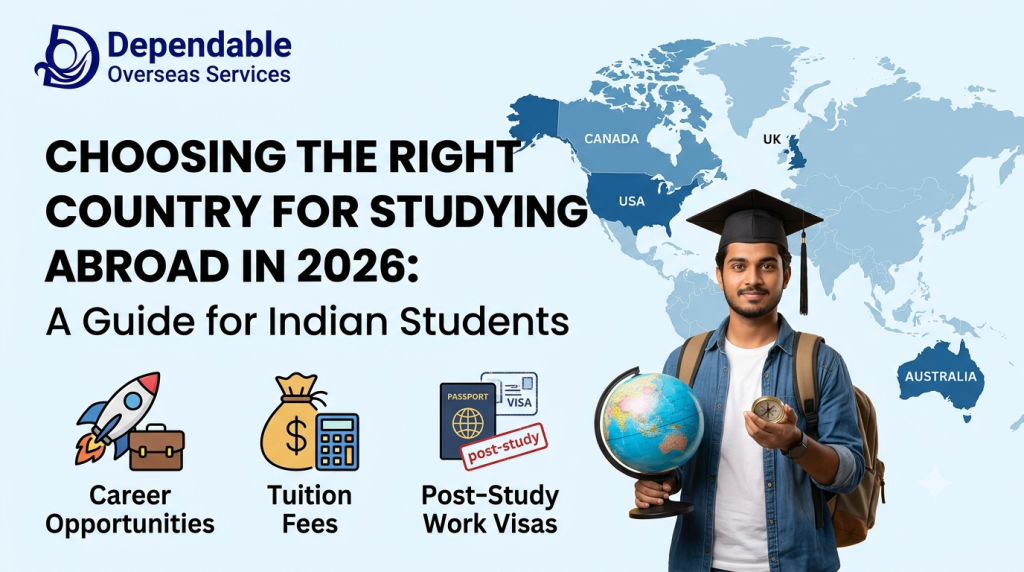
How can Indian students choose the right country for studying abroad in 2026 based on career opportunities, tuition fees, and post-study work visas?
Indian students can choose the right country in 2026 by first deciding their priorities, then comparing a few top destinations on career scope, total cost, and post‑study work rights instead of just “which country is best.”
Step 1: Decide your priority
Before picking a country, be clear on what matters most for you:
Career and PR focus: Long post‑study work visas and clear PR options (good for those wanting to settle abroad). Canada, Australia, Germany, Ireland score well here.
Low tuition fees: Germany (public universities), some European countries, and a few others with low or no tuition.
Brand value and salary: USA, UK, and some EU countries give very strong global recognition but at higher cost.
Try ranking these three for yourself (Career, Cost, PR/Stay) from 1 to 3 so it’s easier to compare countries.
Step 2: Compare key countries on 3 factors
Here is a simple table of popular options for Indian students in 2026.[shiksha]
| Country | Approx yearly tuition (universities) | Post‑study work visa | Career highlights for Indians |
|---|---|---|---|
| USA | 25,000–60,000 USD | 1–3 years (OPT, longer for STEM) | Strong tech, STEM, business jobs and high salaries, but very competitive visas. |
| Canada | 20,000–40,000 CAD | Up to 3 years (PGWP) | Good chances for PR, strong demand in IT, business, healthcare, and engineering. |
| UK | 12,000–35,000+ GBP | 2 years (Graduate Route) | Great for management, finance, business; 1‑year master’s, but PR is tougher. |
| Australia | 22,000–50,000 AUD | 2–4 years depending on degree level | Good jobs in IT, engineering, healthcare; relatively clearer PR pathways. |
| Germa | 0–3,000 EUR (public) | 18‑month job seeker visa | Very low tuition, strong in engineering/IT; need German for many jobs. |
| Ireland | 12,000–20,000 EUR | 2 years | Growing IT, pharma, finance hub; English‑speaking EU country. |
Use this table with your priorities: for example, if fees are a big issue, Germany or Canada may beat USA/UK; if top‑paying tech jobs are your goal and you can afford high cost, USA might be worth it.
Step 3: Match country with your career field
Different fields have different “best” countries:
Tech / CS / Data: USA, Canada, Germany, Ireland have strong demand and good salaries.
Engineering: Germany, USA, Canada, Australia are strong, especially for mechanical, automotive, civil, and electrical.
Business / Finance / Management: UK, USA, Canada popular for MBAs and business masters.
Healthcare / Nursing / Allied health: Australia and Canada are strong for long‑term roles and PR chances.
So first pick your target field and role (for example: “data analyst in Canada” or “mechanical engineer in Germany”), then ask:
Is this country hiring in my field in 2026?
Will I get enough post‑study work time to find a job?
Step 4: Check total cost and return on investment (ROI)
Do not look at tuition alone; add living cost and expected starting salary:
Total annual cost = tuition + living (rent, food, transport).
Compare this with typical starting salaries in that country for your field to judge whether the investment is realistic.
Some countries have higher fees but better salaries and networks (for example USA), others have low fees but smaller salaries (for example some EU countries).
If your family budget is tight, focus on:
Low‑tuition or public universities (Germany, some EU countries).
Countries with good scholarships or assistantships.
Step 5: Evaluate post‑study work and PR realistically
For 2026 intakes, Indian students should check:
Length of post‑study work visa: Longer stays (Canada up to 3 years, Australia 2–4 years, Germany 18 months, UK 2 years) give more time to find a job.
PR path: Canada and Australia are known for comparatively clearer PR routes; Germany and some EU countries use job + long‑term residence paths.
Visa trends: Some sources caution that US and UK may be riskier or more expensive in 2026 unless you have a strong budget and profile.
You should read the latest student visa pages of each country’s official immigration website before finalizing, because rules can change close to your intake.
To turn all this into a personal decision, the next step is: shortlist 2–3 countries that fit your budget and field, then we can compare them in more detail for you. What is your planned course (for example BSc CS, MBA, MS in Data Science, Nursing, etc.) and your approximate yearly budget in rupees? Let Dependable Overseas help you plan accordingly.