
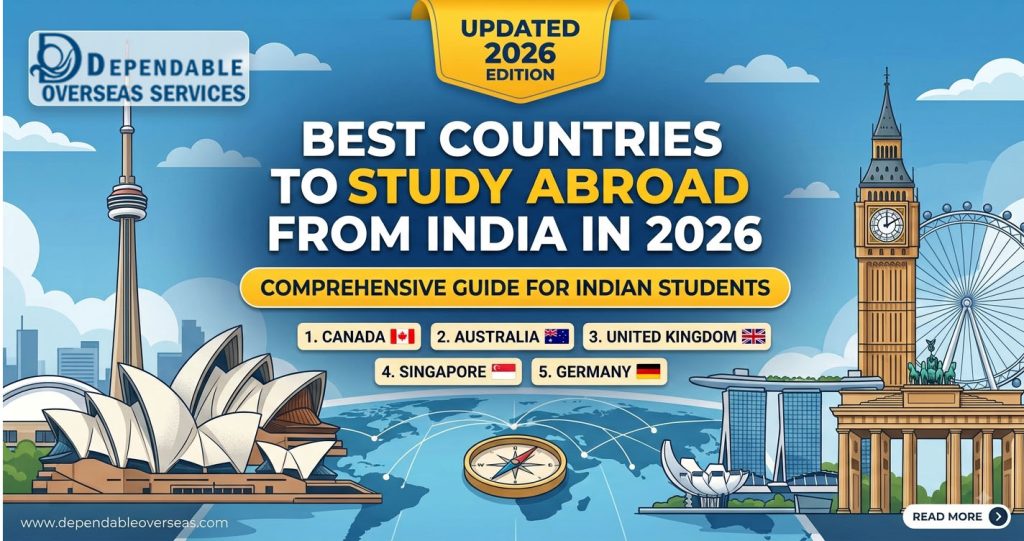
Choosing the right country for higher education is an important decision for Indian students. In 2026, students should look beyond university rankings and compare tuition fees, visa conditions, part-time work rules, job opportunities and quality of life.
Canada, Australia, the UK, Singapore and Germany remain popular choices. However, each destination is suitable for a different type of student.
Quick comparison
| Country | Indicative tuition fees per year | Student visa outlook | Job prospects | Quality of life |
|---|---|---|---|---|
| Canada | CAD 20,000–45,000 | More selective; around 36% approval for new post-secondary study permits in 2026 | Strong in technology, healthcare, engineering and business | Safe, multicultural and welcoming, but housing can be expensive |
| Australia | AUD 25,000–55,000 | Strong for well-prepared higher education applications, but assessment is becoming stricter | Good in healthcare, engineering, IT, construction and education | Excellent lifestyle, high wages and outdoor culture |
| UK | GBP 15,000–40,000 | Generally high; overall student visa grant rate was about 96% in 2025 | Good in finance, technology, healthcare, consulting and creative industries | Diverse, well-connected and academically strong |
| Singapore | SGD 17,000–50,000 after possible grants | No widely published, country-specific approval rate comparable with the other countries | Hotel Management, Excellent in finance, technology, logistics, biotechnology and business | Very safe, modern and close to India |
| Germany | Usually €0 tuition at most public universities, plus semester fees | No simple public approval percentage for Indian students | Strong in engineering, automotive, manufacturing, IT and renewable energy | Safe, affordable in many cities and student-friendly |
Fees are indicative estimates. Actual costs depend on the university, course, city and currency exchange rate.
1. Canada
Canada has traditionally been one of the most popular destinations for Indian students because of its multicultural society, high-quality institutions and post-study work opportunities.
However, Canadian student visa policies have become more selective. Canada approved only about 36% of new post-secondary study permit applications in 2025. This means students need a clear study plan, strong financial documents, a relevant academic background and a credible explanation for choosing their course.applyboard
Tuition fees in Canada
International students can expect to pay approximately:
CAD 20,000–45,000 per year for many undergraduate programmes.
CAD 20,000–40,000 per year for many postgraduate programmes.
Higher fees for medicine, business, dentistry and specialised courses.
Students must also budget for accommodation, health insurance, food, transport and other living expenses. Toronto, Vancouver and other major cities are usually more expensive than smaller Canadian cities.
Job prospects
Canada offers opportunities in:
Information technology and software development.
Healthcare and nursing.
Engineering and skilled trades.
Data analytics and artificial intelligence.
Finance, accounting and business services.
Eligible students can work up to 24 hours per week off campus during academic sessions. Eligible graduates may also apply for a Post-Graduation Work Permit, subject to current programme and immigration rules.canada+1
Quality of life
Canada is known for its safety, cultural diversity and welcoming communities. Indian students can find established Indian communities, vegetarian food and cultural associations in most major cities.
The main challenges are cold winters, high rent and increased competition for accommodation and jobs. Canada may be a good option for students who have a strong academic profile and can present a well-prepared visa application.
2. Australia
Australia is a strong choice for students who want globally recognised universities, a high standard of living and access to a diverse job market.
The country has introduced tighter checks for student visa applications. A genuine course choice, financial capacity and consistent academic history are increasingly important.
Tuition fees in Australia
Typical international tuition fees are approximately:
AUD 25,000–45,000 per year for undergraduate courses.
AUD 25,000–55,000 per year for postgraduate courses.
More for medicine, dentistry, MBA and specialised programmes.
Living costs can be high in Sydney, Melbourne and Brisbane. Students may reduce expenses by choosing regional locations, shared accommodation and public transport.
Job prospects
Australia has demand in areas such as:
Nursing and allied healthcare.
Information technology and cybersecurity.
Engineering and construction.
Teaching and early childhood education.
Accounting, agriculture and environmental science.
International students can generally work up to 48 hours per fortnight while their course is in session. Eligible graduates may apply for the Temporary Graduate visa, although eligibility and post-study work periods depend on the qualification and current rules.immi.homeaffairs+1
Quality of life
Australia offers a relaxed lifestyle, good infrastructure, beautiful beaches and a multicultural environment. It is also geographically closer to India than Canada or the UK.
The key disadvantages are high tuition fees, expensive accommodation in major cities and strict visa assessment. Australia is particularly suitable for students who value lifestyle, practical education and career opportunities in healthcare, engineering or technology.
3. The United Kingdom
The UK remains one of the best destinations for Indian students who want shorter degree programmes and access to internationally respected universities.
Many master’s degrees can be completed in one year, which may reduce the total cost of education and allow students to enter the job market sooner.
Tuition fees in the UK
International tuition fees usually range between:
GBP 15,000–30,000 per year for many undergraduate courses.
GBP 16,000–40,000 per year for many postgraduate courses.
Higher fees for medicine, business, law and laboratory-based programmes.
London is one of the most expensive student cities in the UK. Students can often lower their living costs by choosing universities in cities such as Manchester, Birmingham, Leeds, Sheffield, Nottingham or Newcastle.
Job prospects
The UK has strong employment opportunities in:
Finance and banking.
Software development and data science.
Healthcare and life sciences.
Engineering.
Consulting, marketing and creative industries.
The Graduate Route allows eligible international graduates to stay in the UK for up to two years after completing an eligible degree. PhD graduates may receive up to three years. The UK government has stated that the period will reduce to 18 months for applications made on or after 1 January 2027.www
Quality of life
The UK offers excellent public transport, historic universities and a large international student community. Indian students also benefit from cultural diversity and relatively easy travel across Europe.
The main challenges include high rent, a competitive graduate job market and changing immigration policies. The UK is a good option for students who want a shorter master’s programme or plan to work in finance, technology, healthcare or consulting.
4. Singapore
Singapore is an attractive destination for Indian students who prefer to study in Asia. It is close to India, highly developed and home to leading universities such as the National University of Singapore and Nanyang Technological University.
Tuition fees in Singapore
International tuition fees can vary significantly:
Around SGD 17,000–25,000 per year for many subsidised undergraduate programmes.
Around SGD 25,000–50,000 or more for non-subsidised and specialised programmes.
Medicine, dentistry and some professional courses can cost substantially more.
The Ministry of Education Tuition Grant may reduce tuition fees for eligible international students. However, students who accept the grant generally commit to working in Singapore for three years after graduation.unilink
Job prospects
Singapore has a strong economy and good opportunities in:
Banking and financial services.
- Hotel Management
Information technology and artificial intelligence.
Logistics and supply chain management.
Biotechnology and pharmaceuticals.
Business, consulting and fintech.
The job market is competitive, and finding employment depends heavily on the university, course, academic performance and employer sponsorship requirements.
Quality of life
Singapore is clean, safe and well connected. English is widely used in education and the workplace, which can make the transition easier for Indian students.
The biggest challenges are high living costs, limited space and a competitive employment market. Singapore is best suited to students who want an Asia-focused career in technology, finance, business or logistics.
5. Germany
Germany is one of the most cost-effective destinations for Indian students, particularly those interested in engineering, technology and research.
Most public universities do not charge tuition fees for international students. Students usually pay a semester contribution, while some states and universities have separate fees. For example, non-EU students in Baden-Württemberg may be charged €1,500 per semester at public institutions.uni-heidelberg
Tuition fees in Germany
Students should budget for:
Usually €0 tuition at most public universities.
Approximately €100–430 per semester in semester contributions.
Around €11,000–16,000 per year for living expenses.
€10,000–24,000 or more per year at many private universities.
Germany is affordable in terms of tuition, but students must show sufficient funds for living costs when applying for a visa.
Job prospects
Germany has strong career opportunities in:
Mechanical and automotive engineering.
Electrical and industrial engineering.
Software development and IT.
Renewable energy.
Manufacturing and research.
Supply chain and logistics.
International students can generally work up to 140 full days or 280 half days per year under current rules. German language skills can significantly improve employment opportunities, especially outside international companies.uni-heidelberg
Quality of life
Germany offers good public transport, strong worker protections, affordable student services and a high standard of education. Cities such as Berlin, Munich, Frankfurt, Hamburg and Aachen have active student communities.
The main challenges are German-language requirements, paperwork and accommodation shortages in popular cities. Germany is an excellent choice for students who want lower tuition costs and are willing to learn German.
Which country is best for Indian students?
There is no single best country for every student. The right choice depends on your budget, academic background, preferred course and long-term career plans.
Best for lower tuition: Germany.
Best for a short master’s degree: The UK.
Best for lifestyle and healthcare careers: Australia.
Best for a multicultural environment: Canada.
Best for an Asia-focused business or technology career: Singapore.
Best for engineering and manufacturing: Germany.
Best for finance and consulting: The UK or Singapore.
Best for technology and data careers: Canada, Australia, Germany or Singapore.
How to choose your destination
Before applying, compare the following factors:
Total cost: Calculate tuition, rent, food, insurance, travel and visa-related expenses.
Course quality: Check the curriculum, accreditation, placement options and internship opportunities.
Visa requirements: Do not rely on general approval-rate claims. Visa decisions depend on your individual profile and documents.
Post-study work rules: Check whether your exact course and institution qualify for post-study work options.
Job market: Research demand for your profession instead of choosing a country only because it is popular.
Language: English may be enough for study, but local-language skills can improve your employment options.
City and lifestyle: Consider safety, climate, transport, healthcare and distance from India.
Final verdict
For most Indian students in 2026, Germany offers the best value for money, while the UK offers speed through shorter master’s programmes. Australia remains attractive for lifestyle and career opportunities, Canada is suitable for students with strong visa profiles, and Singapore is ideal for students targeting Asia’s technology and business sectors.
A successful study-abroad plan begins with the right course and a realistic financial and visa strategy. Avoid choosing a country based only on advertisements or informal visa guarantees.
Planning to study abroad in 2026? Visit Dependable Overseas for personalised guidance on university selection, applications, scholarships and student visa preparation. Our team can help you choose a study destination that matches your academic goals, budget and career plans.
Note: Tuition fees, visa policies, work rights and post-study routes can change. Students should verify the latest requirements on the official immigration and university websites before applying.